
The Sequence Problem in Learning
Agile L&D fixes how you deliver training. The constraint was never delivery.

The L&D world has found its answer.
Agile. Sprints. Minimum viable products. Employee experience treated as a product to be designed, iterated, and continuously improved. T-shaped teams with broad skills and deep expertise working in short cycles close to the business.
The traditional curriculum calendar, the annual training catalogue, the completion rate and entertainment value as the proxy for success. These are genuinely broken.
The Agile critique of traditional L&D is accurate: most learning functions are too slow, too disconnected from what the business actually needs, and too focused on producing content instead of producing results. Scott Morris and i dove into this on a recent podcast, which i think is worth a listen.
The adoption of agile has been real. Heads of learning and development are standing up sprint ceremonies and designing with empathy for the learner. Learning teams are hiring product managers and UX researchers.
Organizations are separating business-as-usual from project work, running retrospectives, building MVPs, iterating on feedback. Some have embedded L&D practitioners inside business units rather than centralizing them in HR.
The investment is serious. The intent is genuine.
The results are mostly the same.
L&D is still fighting for budget. Still getting cut when margins compress. Still being told by business leaders that the function doesn’t understand the business, doesn’t move fast enough, doesn’t produce returns that justify the investment.
Before diagnosing why, the Agile critique deserves its full credit.
Annual curriculum calendars producing content no one uses. Completion rates measured against programs designed by people who assumed they knew what the business needed without asking. Activity measured as a proxy for impact because no one ever defined what impact meant. These are real problems.
Agile restores contact with the business. Shorter cycles, tighter feedback loops, and a product mindset move L&D closer to real need. The methodology also solves for feedback, which the traditional function never managed. A learning team working on a six-month curriculum has no mechanism for discovering whether the problem changed while the content was being built.
An Agile team working in two-week cycles discovers this constantly. That responsiveness is real, and the business sees it. The frustration sets in when responsiveness and impact are treated as equivalent. They are not.
The Mandate Agile Inherited
The constraint is not the delivery methodology. It is the mandate.
L&D functions are primrily measured by what they produce. Programs delivered. Completion rates. Learner satisfaction scores. Hours of training consumed.
These metrics are legible, easy to count, and almost entirely disconnected from the outcomes the business cares about. Revenue per head. Speed to productivity in critical roles. The performance variance in positions where execution quality has the largest strategic cost.
Agile makes the activity machine more responsive. It does not change what the machine is accountable for producing.
Traditional L&D functions were built around a single organizing principle: content production. Subject matter experts who built courses on annual cycles, deploying programs against a predetermined curriculum whether or not the business had changed around them.
That model breaks contact with the business by design. Agile restores contact. It does not change the accountability structure the content is being produced under.
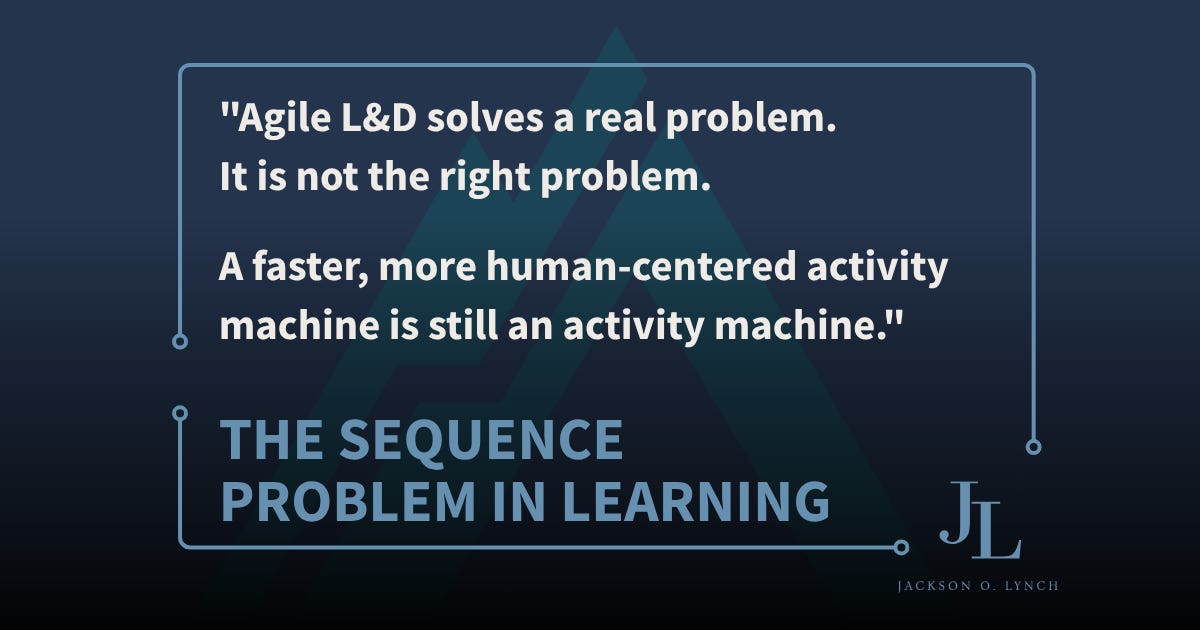
A faster, more human-centered activity machine is still an activity machine.
What the Budget Conversation Teaches the Organization
The mechanism that sustains this is worth understanding precisely.
When a head of learning and development justifies the learning budget, the conversation gravitates toward what can be counted. How many employees completed the program? What was the satisfaction score? How many hours of learning were consumed?
These numbers exist, they are defensible, and leadership has accepted them as evidence of L&D functioning long enough that they became the standard.
The measurement infrastructure shapes the mandate over time. What gets measured defines what the system believes it is producing.
The durability comes from two sources. First, activity metrics are easy to produce and impossible to argue with. Nobody disputes that eighty-seven percent of managers completed the program. Whether that completion changed anything is harder to establish, and in the absence of a clear answer, the number stands. Second, the business has implicitly accepted this arrangement: they never held L&D accountable for outcomes because they never defined what outcomes L&D should produce. The CHRO never established the connection.
So the function reports what it can count, and the business approves it, because challenging it would require a harder conversation neither side has been ready to have.
The Sequence Question
A mandate is the explicit definition of what a function is accountable for producing, measured in terms the business uses to evaluate performance.
Most L&D mandates are activity mandates. Build programs. Deliver curricula. Support the talent strategy. These describe what the function does. They do not describe what the function produces that the business cannot afford to lose.
An outcome mandate looks different from the start. It begins with the pivotal roles in the organization. The handful of positions that disproportionately drive enterprise value, execution speed, and strategic risk.
What is the performance gap in these roles today? What does that gap cost?
When a critical commercial leadership role underperforms by fifteen percent, there is a number attached to that.
When onboarding takes four months instead of eight weeks to bring a new hire to full productivity, the delay has a cost in revenue and in drag on the manager’s capacity.
When succession depth at a critical leadership tier is insufficient, the exposure has a probability and a consequence that can be quantified if anyone takes a moment to do the math.
The mandate also shapes what L&D prioritizes.
An activity-based mandate pushes the function toward coverage: broad programs that reach the most employees produce better utilization metrics.
An outcome-based mandate pushes toward concentration: deep, targeted capability building in the pivotal roles that produce disproportionate enterprise results.
Coverage and concentration require different architectures, different team structures, and different conversations with the business about where investment goes.
Most L&D functions are optimized for coverage because that is what their mandate rewards. Agile makes coverage-optimized functions faster.
The structural misalignment persists.
This is why the transformation requires the CHRO, not the head of learning and development. The head of learning and development can adopt Agile and build a genuinely better learning experience. What the head of learning and development cannot do alone is reset the mandate the function operates under.
Mandate clarity is a governance decision. It requires the CHRO to define, in business language, what L&D will be held accountable for producing.
It requires the CEO and CFO to understand the connection between learning investment and performance in pivotal roles.
Many CHROs have positioned L&D as an HR program rather than as a performance-producing architecture, defending the budget in terms of employee experience and culture rather than execution reliability and performance velocity in the roles that drive results. I understand this, because for years I did that very exercise.
That framing limits the mandate before the head of learning and development ever makes a decision.
The organizations where Agile L&D is producing measurable performance improvement share a prior condition. Someone decided, before adopting the methodology, that L&D would be accountable for performance outcomes in specific roles. The mandate was reset. The measurement infrastructure changed. Then Agile gave the team a faster, more human-centered way to pursue those outcomes. The methodology worked because the foundation was correct.
Sequence matters. Mandate first. Methodology second.
L&D has never lacked for good methodologies or talented developers. It has lacked for mandates that make the connection between learning investment and business performance explicit, measurable, and owned by someone whose job depends on the result.
Talent Sherpa Key Takeaway
The Agile L&D movement has done real work identifying what is broken about traditional learning delivery. The tools are sound. The sequence is wrong.
The mandate defines what the system produces. When activity accountability precedes outcome accountability, every methodology improvement produces a better activity machine.
The measurement infrastructure, the budget conversation, the board’s understanding of what L&D is for. All of these persist until someone with the authority to reset them does.
The CHRO who resets the L&D mandate from activity production to outcome accountability owns a different conversation with the CEO, the CFO, and the board.
That conversation creates the conditions in which Agile L&D delivers what it promises. The methodology question becomes answerable once the mandate question is answered. Not before.
That sequence belongs to you.
Keep climbing.